

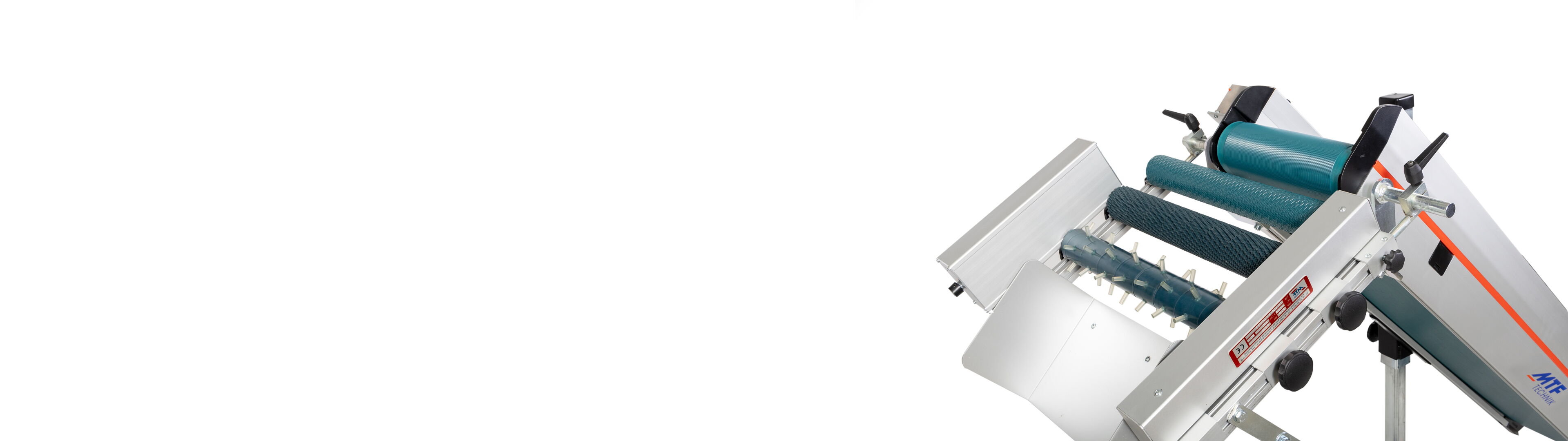
Automated separation on conveyor belts – flexible and reliable
MTF Technik roller separators are used for the spatial separation of parts of different sizes. They are used in particular in the plastics industry and die casting to separate moulded parts from sprues.
They are integrated directly into the process, i.e. separation takes place "shot by shot". As a rule, a machine discharge belt conveys the produced parts directly to the feed area of the roller separators. This means, for example, that sprues can be ground directly on the production machine and fed back into the production process.Depending on the task at hand, various designs are available to achieve optimum separation results.
We would be happy to carry out separation tests for you in our technical centre and document them on video. This allows us to guarantee the separation result you require.
- Our products
- Your advantages
- Roller separators in detail
- FAQ
Filter products


Why should you choose MTF Technik?
Customised product manufacturing
Special solutions
Comprehensive service
Expertise for over 50 years
Patented technologies
Advantages of MTF Technik Roller separators
Double-sided mounting of the separating rollers for precise separation gap
Separator column can be conveniently adjusted using star handles adjustable
Integrated, maintenance-free drum motor drive with its own speed control
Easy adjustment without tools possible
Minimal changeover times to different part combinations
Variable mounting bracket for easy integration into existing processes.
Sturdy drip tray for clean part delivery
Extremely simple operation and high work safety
The roller separators in detail
Efficient separation of good parts and sprues
Efficient separation of good parts and sprues
Roller separators are used to sort materials of different shapes and sizes. They are typically used in plastic injection moulding to separate finished parts from sprues. Roller separators can be used to sort parts of different surface areas but the same thickness.
The roller separators consist of at least one and at most three separating rollers. The drum motor drive is integrated into the first separating roller. The other rollers are driven by a side chain drive from the first roller. The drive is an efficient DC drum motor with a power output of only 30W and its own control system, which allows the rotational speed to be set in 15 steps between 15 and 92 rpm.
The separator is positioned downstream of the discharge side of a conveyor belt, with the distance between the conveyor belt roller and the first separating roller already forming a separation gap. The material to be separated is fed in batches, i.e. usually shot by shot directly after each production cycle, onto the roller separator.
Small parts fall down into this gap and can be collected there in a container. Large parts are transported over the separating roller(s) and fall down behind the (last) roller onto the drip tray, where they can be directed into a second collection container.
The individual separating rollers can be adjusted separately. They can be moved freely on the linkage and fixed in place using small star handles. This means that adjustments can be made quickly and without tools. The separating rollers are fitted with individual linings made of PVC, PU, felt, silicone, rubber, etc. with smooth, knobbly or structured surfaces. These are defined depending on the part geometry, the general conditions and customer requirements in terms of colour and surface. The last separating roller can also be fitted with a special PVC coating with spikes. This serves to artificially enlarge the last separation gap in order to improve the separation result.
As a special feature, the individual rollers can also be equipped with individual disc elements. These serrated elements create an additional dimension to the separation gap. Instead of long gaps, smaller holes are formed. In addition, the interlocking elements serve as a support for sprues that have a long injection channel, which would otherwise become caught in the separation gap of a standard roller separator. The design of the roller separators can be customised to the respective separation task if required. Free-standing units on their own frame are just as possible as units that are to be mounted on external conveyor belts.
We would be happy to provide you with personal advice for your individual requirements.
Questions and answers about Roller separators
Why is it advantageous to have a separate drive on a separator?
Some manufacturers of separator attachments drive the separator via an upstream conveyor belt, meaning that the speed of the separator depends on the speed of the conveyor belt.
However, it is often the case that a low or even cyclical belt speed is desirable on one side – e.g. to cool parts – while separation must take place at a higher speed on the other side in order to achieve an optimum result.
For this reason, MTF Technik uses its own drive for the separators. This allows transport and separation to take place independently of each other, achieving an optimal overall result.
Why are drive cleats on the feed conveyor belt problematic for a roller separator?
The first separating roller of the roller separator is mounted directly after the discharge side of a conveyor belt. The distance between these two rollers is the first separating gap through which small parts can fall down.
Since the drive lugs must pass through this first gap unobstructed, their height defines the minimum distance or minimum separation gap. To ensure flexibility, it is advisable to equip the conveyor belt with an adhesive or structured conveyor belt so that no or only low drive lugs can be used.
Why is it so important that the separating rollers are mounted on both sides?
The individual separation gaps can only be adjusted precisely if the individual separating rollers are mounted and guided on both sides. If the rollers are mounted on one side only, there is a risk that they will start to wobble. This makes precise adjustment impossible and the separation result suffers.
Can MTF Technik roller separators also be mounted on conveyor belts from other manufacturers?
Yes. Since the roller separators have their own drum motor drive, they can generally be used independently. To mount them on a third-party conveyor belt, all you need to do is create the connection in the form of round steel mountings to which the attachment can be fastened.
Are the roller separators available in different sizes?
Yes. The roll separators from MTF Technik are available in widths of 400 mm, 600 mm and 800 mm as standard. One, two or three separating rolls with individual coatings can be used.
Why are some roller separators additionally equipped with discs?
The serrated discs, which can be fitted to the rollers, enable an additional dimension to be added to the separation gap. Roller separators create long gaps between two parallel rollers. Disc separators create smaller holes.
In addition, the interlocking discs form a kind of support that guides flat sprues with a long protruding injection point over the rollers. Otherwise, the injection point would possibly get stuck in the separation gap of a "normal" roller separator.
Why is the last roller of a roller separator often equipped with a spiked coating?
Depending on the part/sprue geometry, it makes sense to equip the last roller of a roller separator with a spike coating, as this allows the last separation gap to be enlarged. Due to the direction of rotation of the rollers, the spikes effectively rise up from the bottom of the separation gap and pick up the larger parts there. This results in larger separation gaps for the smaller parts, thus improving the separation result.
This "trick" only works on the last roller, as otherwise the spikes would pull the larger components into a separation gap on the discharge side.
Why are the rollers of a roller separator equipped with adhesive coatings?
The separating rollers must transport the separated material safely in the direction of conveyance over the rollers. If the coating were too slippery, the parts would remain on the separator for too long and possibly become jammed there.