
Efficient distribution and buffering of material MTF Technik 
Hardy Schürfeld GmbH & Co. KG

Efficient distribution and buffering of material

Solutions for splitting and distributing flow rates

Tasks in the field of automation

Manufacturing processes are to be automated in order to increase productivity. The aim is to ensure unmanned shifts or even unmanned weekends and to avoid machine downtime.

The customer places an order to count manufactured parts, e.g. injection moulded, stamped or die-cast parts, and distribute them to different containers.

Solutions for parts buffering

MTF Technik has been involved in the automation of material flow in production facilities for many years. The focus is particularly on automated container management (keywords: box changers and parts buffering).

Here we present various buffer systems that can be designed to suit the task at hand:
In order to find the suitable buffer system for your application, please use the attached checklist.

Rotary storage tables

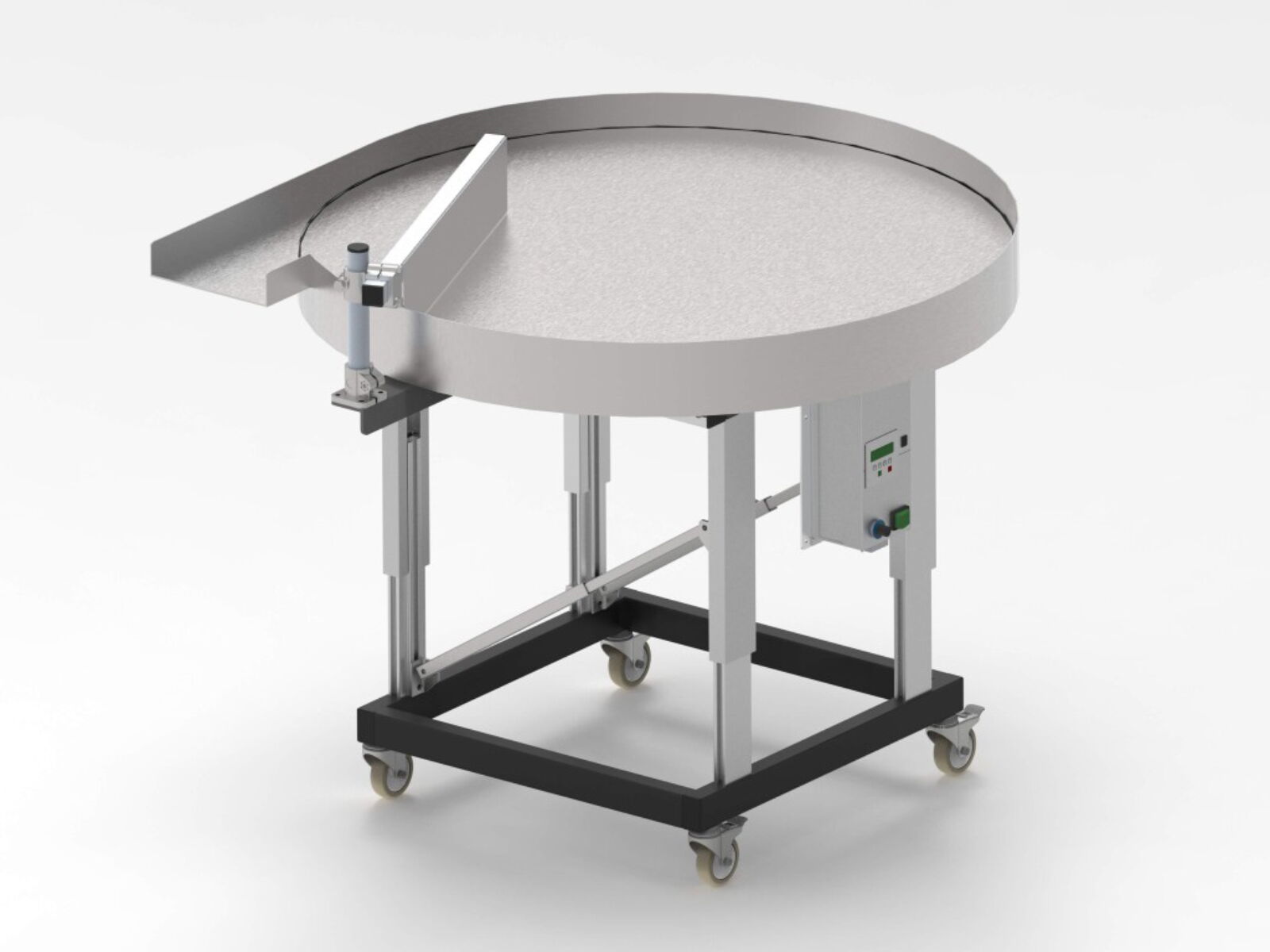
Rotary storage tables are used in particular for the short-term intermediate storage of individual products and are often located at the end of production lines where the parts are then manually packed or handled.

These buffer systems consist of a round turntable enclosed by a fixed side guide. The turntable is driven by an electric motor and rotates clockwise or counterclockwise, depending on the application. Depending on the product and task, the turntable is made of stainless steel or plastic, and the side guide is usually made of stainless steel.

The rotary movement prevents product piles from forming or parts from falling on top of each other and possibly damaging each other. The products are transported in a circle and can be partially guided, fed in and/or ejected by means of appropriate scrapers or guides.

Rotationally symmetrical parts (e.g. after a lathe in metalworking) can be accumulated and separated on these rotary storage tables for feeding into a subsequent process. Here, the rotary tables serve, for example, as short-term buffers to bridge different cycle times of interlinked work steps.

Due to their relatively small size, they are usually equipped with a mobile base frame and can therefore be used flexibly at different locations. Depending on the product geometry, the FIFO principle can even be implemented on the storage tables by using appropriate spirals.

Bunker conveyor belts

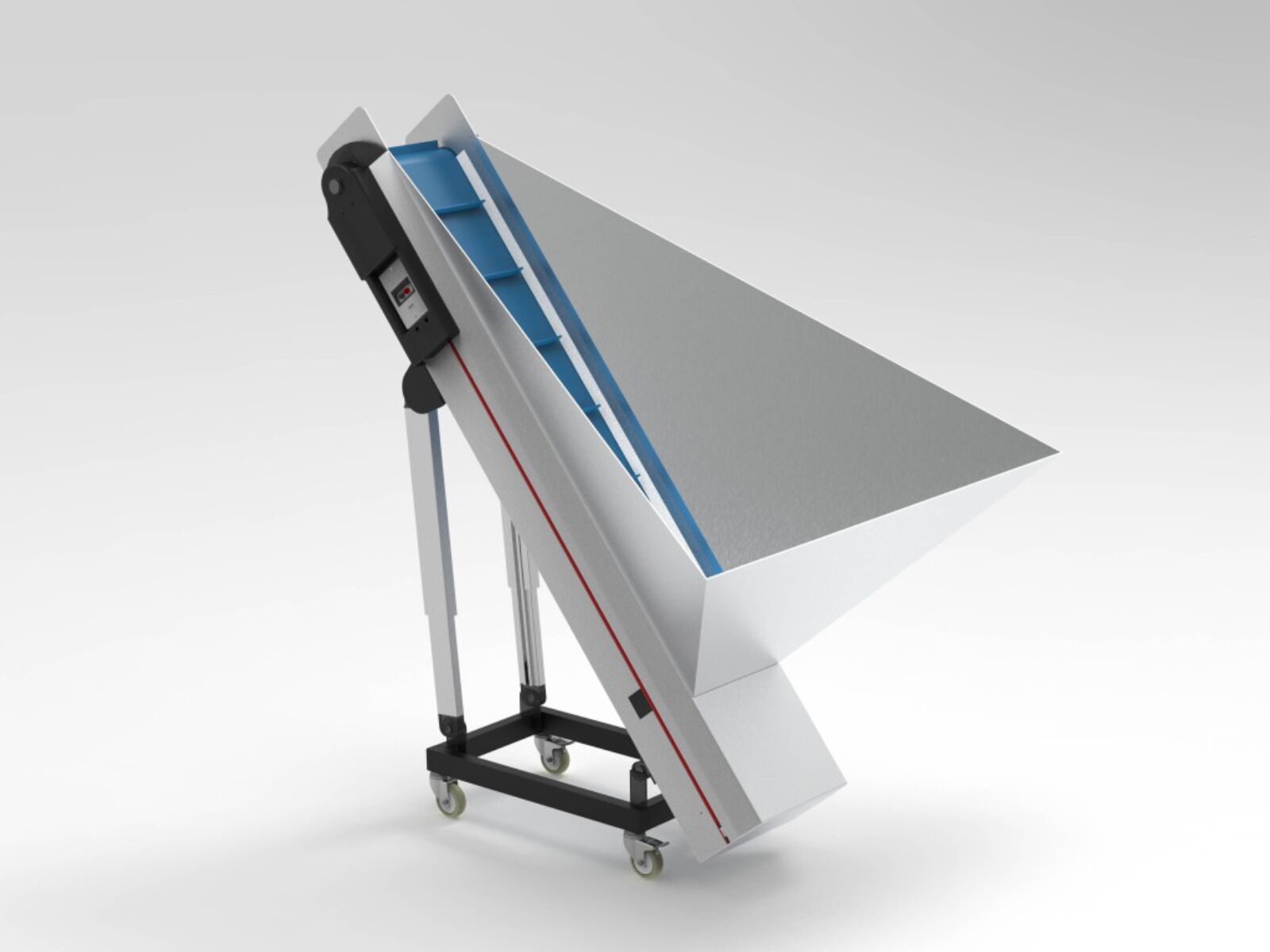
Bunker conveyor belts from MTF Technik are also used for short-term storage of bulk materials. These are usually belt conveyors or steel hinged plate conveyors equipped with a large feed hopper. The hopper volume is then designed according to the part geometry and task. Hoppers with a volume of up to approx. 1.5 m³ are not uncommon.

Such metering conveyor belts are primarily used for feeding material into subsequent processes. They are often used, for example, to fill vibrating pots on assembly lines or to feed separating drums in a central separation task.

Speed-controlled or clocked drives are generally used to enable metered feeding. Depending on the task at hand, feeders can also be implemented in combination with level sensors in a relatively simple manner.

When designing the hoppers for the bunker conveyor belts, careful attention must be paid to the part geometry in order to avoid any jamming or bridging processes.

View

Round table

Efficient distribution and buffering of material MTF Technik 
Hardy Schürfeld GmbH & Co. KG

View

Dosing conveyor belt

Efficient distribution and buffering of material MTF Technik 
Hardy Schürfeld GmbH & Co. KG

Distributor rockers

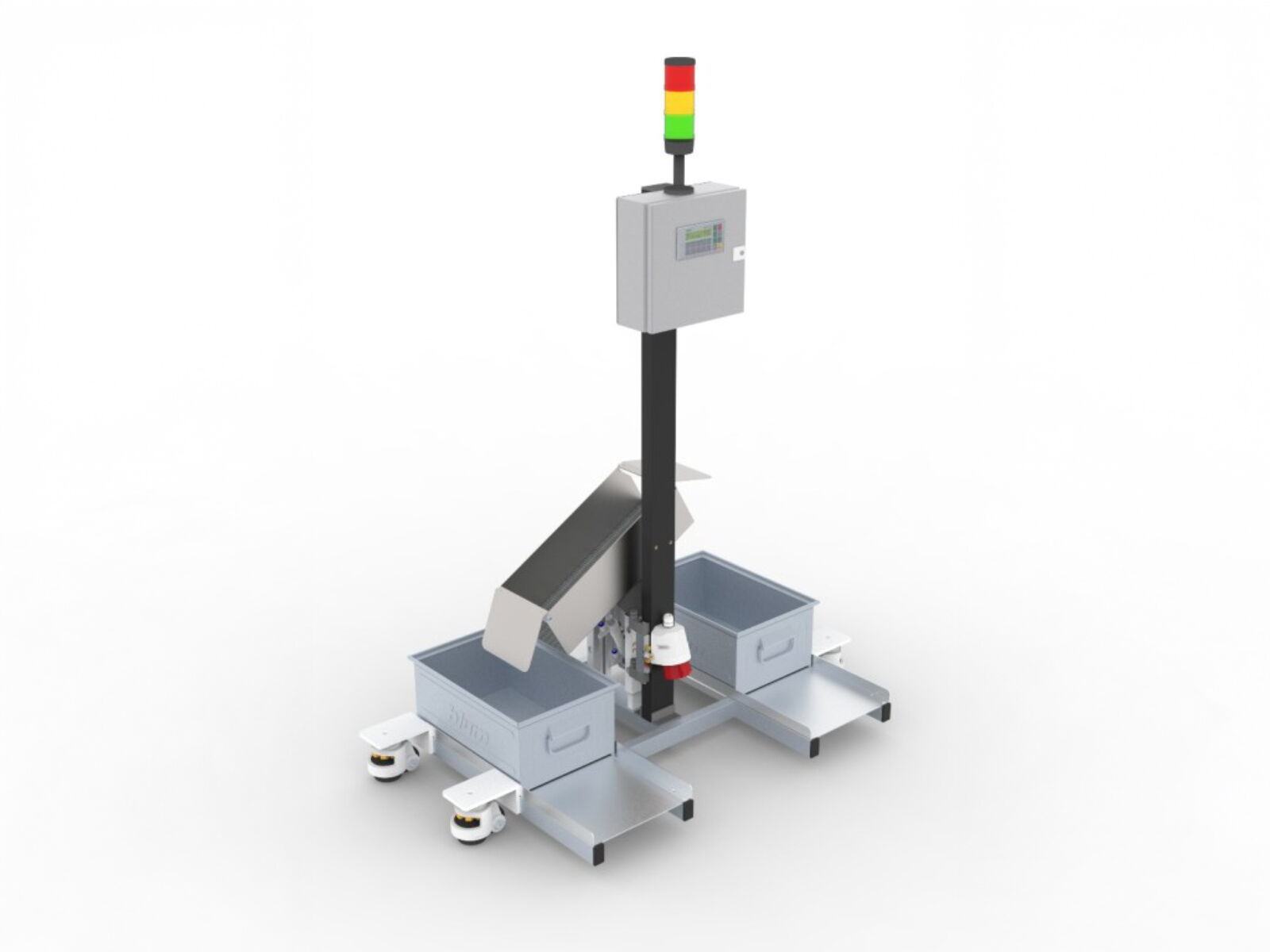
Distributor rockers from MTF Technik are usually pneumatically operated slides that can be tilted into two positions, thereby directing bulk material flows in two directions. Depending on the task at hand, these rockers can be attached directly to the outlet of a conveyor belt or a separating device, for example, or mounted on a separate frame.

These distribution systems are primarily used where space is limited or distribution to two containers is sufficient. For example, two containers can be set up directly next to each other and filled. This ensures optimum use of space.

Due to their simple design, the necessary control functions are also relatively minimal. In the simplest case, a 24V signal is sufficient to switch a spring-return pneumatic valve. Of course, end positions, etc. can also be queried – however, this would require a more complex control system.

2-position distributor rockers are therefore a relatively inexpensive and space-saving option for filling two containers to create a small buffer system.

MTF Technik also offers optional distribution switches that can assume two or even three positions. The switches are similar to the distribution rockers, but are enclosed in a closed housing to protect the flow of parts.


Shift buffers

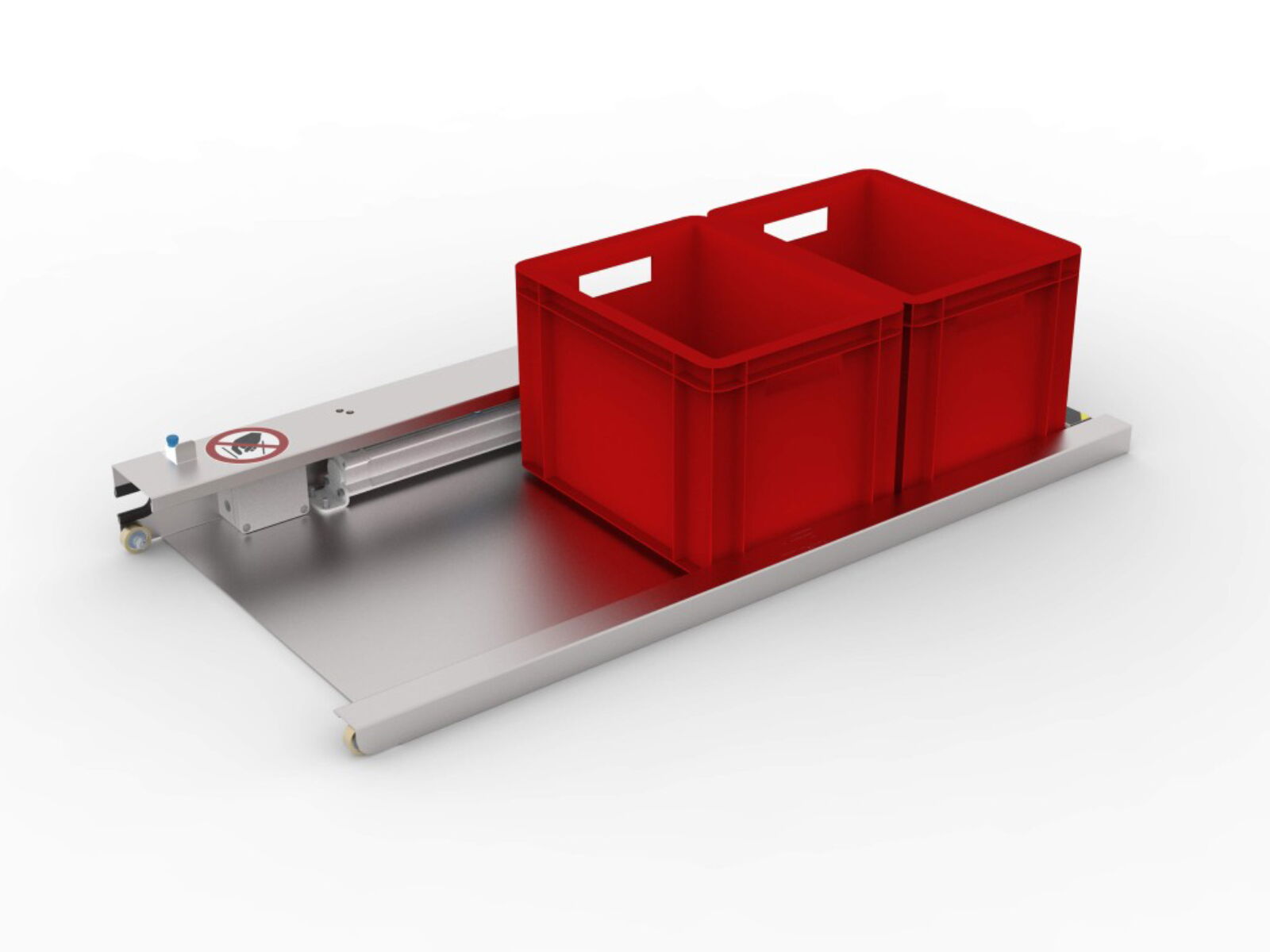
The shift buffers consist in the basic version of a stainless steel sheet base with an integrated pneumatic shift mechanism. Two to three empty containers are placed on the base body, which are then moved forward by means of a shifting arm to change containers.

In the simplest version, no additional control is required. Instead, a 24 V signal can be applied to a spring-return pneumatic valve from an existing machine control system, for example, which only needs to be activated for as long as it takes to move a container. For more complex tasks with more than two containers or intermediate positions – e.g. to avoid spillage cones – a more complex control system must be used.

The main advantage of the shift buffers is their minimal height. The containers stand directly on the floor, supported only by the sheet metal base, which is only a few millimetres high. This makes these buffers particularly suitable for tasks where parts are fed in via low chutes or machine drop chutes, for example.

The displacement buffers are extremely low-maintenance, simple and comparatively inexpensive. They are the ideal solution for achieving low filling heights and require little space.

View

Distributor rocker

Efficient distribution and buffering of material MTF Technik 
Hardy Schürfeld GmbH & Co. KG

View

Shift buffer

Efficient distribution and buffering of material MTF Technik 
Hardy Schürfeld GmbH & Co. KG

Multi-Rounder Rotary Distributor

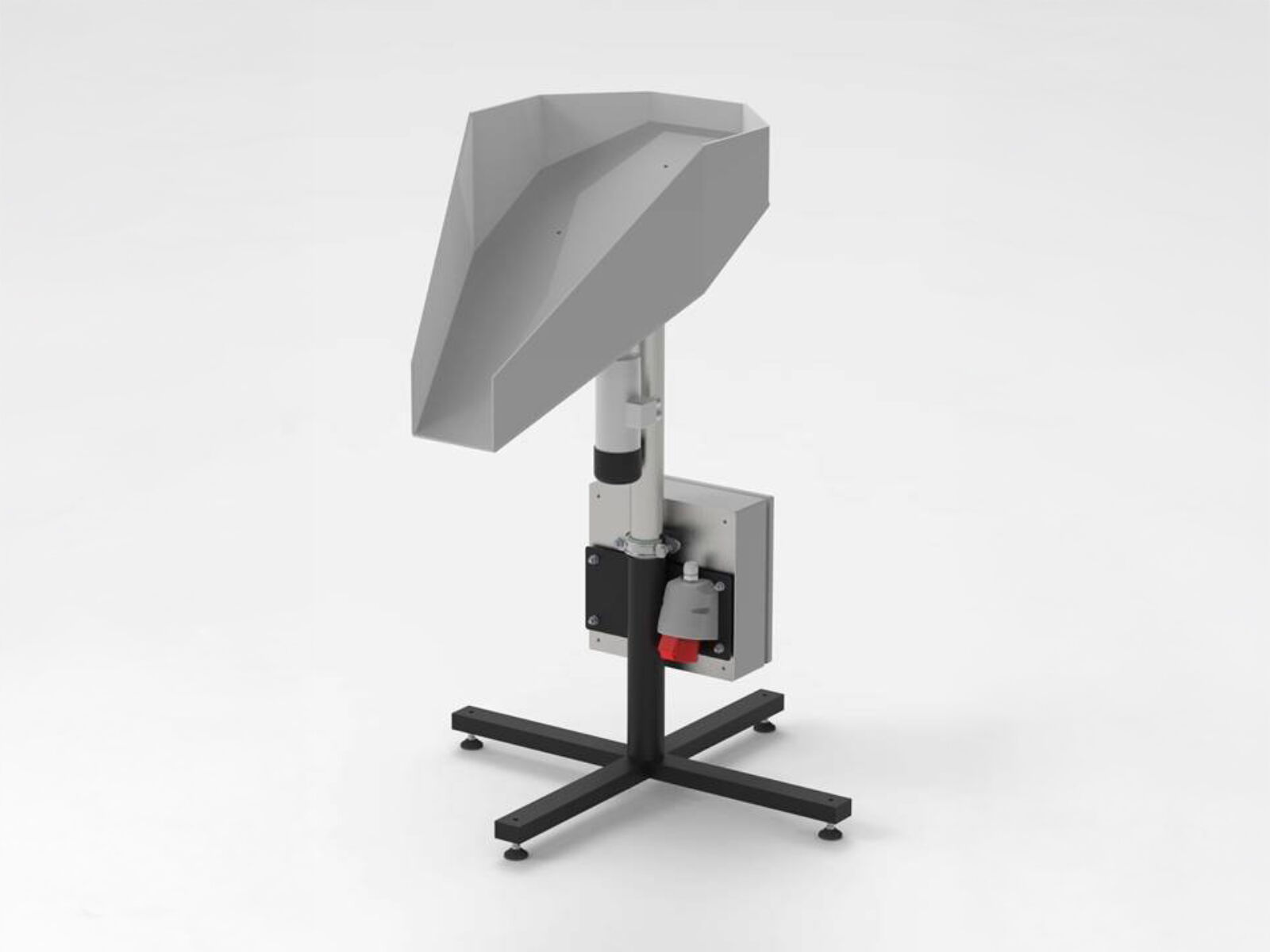
The "Multi Rounder" rotary or swivel distributor is equipped with a chute mounted on a three-phase motor with a brake. The parts slide down the chute into various containers arranged in a circle around the pivot point.

Depending on the version, the rotary distributor can perform complete rotations or, optionally, swing back and forth. This depends primarily on the filling position and the available space or any interfering edges.

The Multi-Rounders can be mounted below the outlet of a conveyor belt or on a separate base frame. Depending on the design of the base frame, container centring, container detection, etc. can also be provided.

A separate control system is usually required for the use of a rotary distributor, which can evaluate the positions and control the drive accordingly. The holding positions can be easily defined on the device by means of cams, as they can be added, moved or removed. This makes it easy to implement intermediate positions, for example, to avoid spillage cones (multiple positions within a container).

Depending on the version, the device can be mobile so that it can be used at different locations without any problems.

Multi-Rounders are generally used where, depending on the arrangement, up to a maximum of six containers are filled, but it is also possible to fill four mesh boxes, for example. The ability to move to multiple positions in a container gives the Multi-Rounder a decisive advantage over distribution rockers or switches, which usually have only one discharge point per container and thus create larger spillage cones.

View

Multi-Rounder

Efficient distribution and buffering of material MTF Technik 
Hardy Schürfeld GmbH & Co. KG

Multi-level conveyor belts

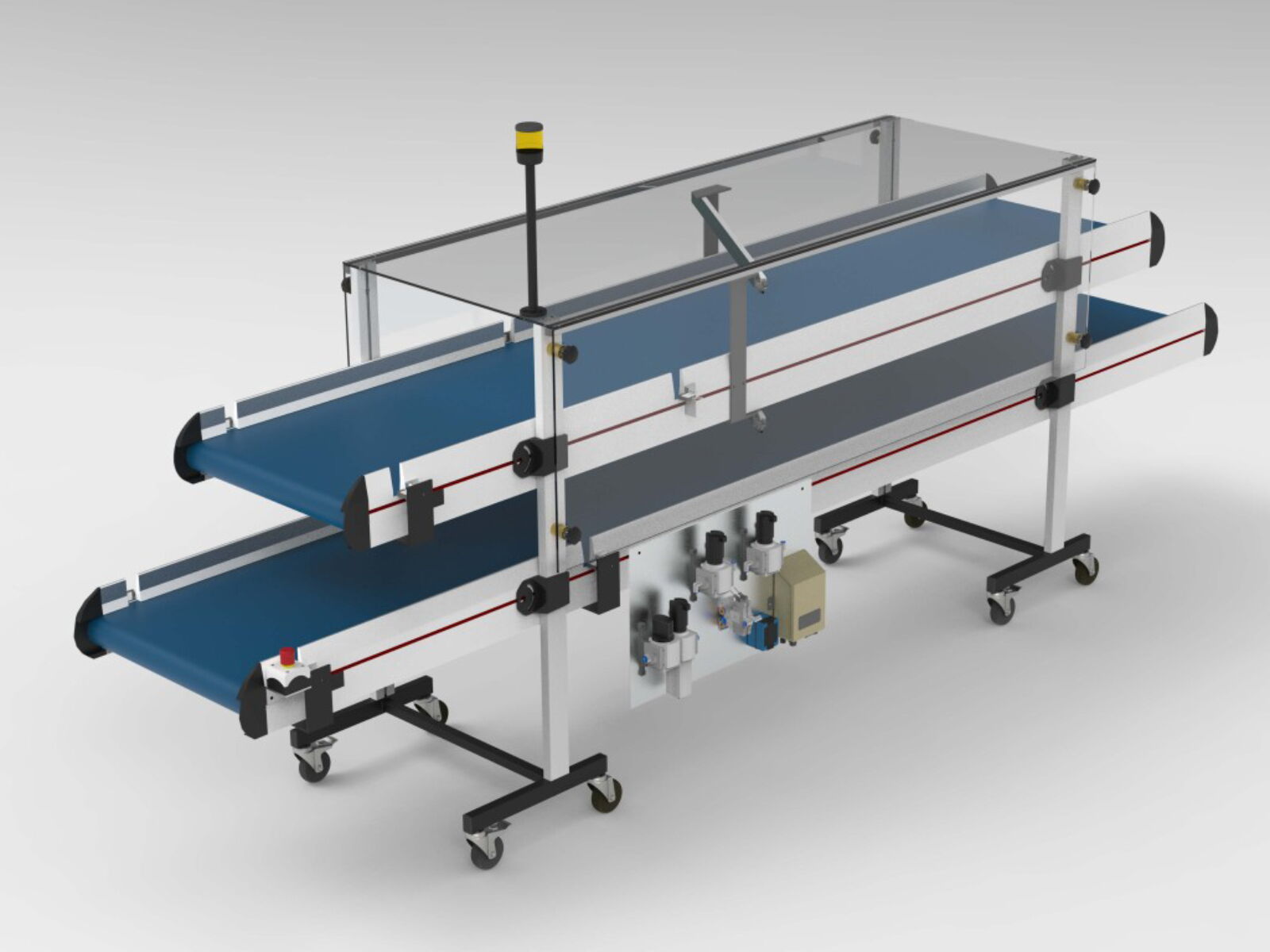
MTF Technik's multi-level conveyor belts are generally used as multi-layer storage areas for individual parts. In most cases, they are used for short-term buffering of products on a production line, e.g. where components are deposited by a robot and transported out of a protective fence. The conveyor belts are usually mounted offset above each other at the belt inlet in order to provide storage space for components on all levels, which can be reached from above by robots.

These conveyor belts often serve to decouple the production process from a manual process, i.e. an operator removes the components on the discharge side. This means, for example, that one level can be filled completely over a longer period of time and the operator then empties the conveyor belt in correspondingly longer cycles.

Depending on the task and the desired buffer period, the conveyor belts are individually designed in terms of length, width and number of levels. Depending on the control technology available on the production line, the multi-level conveyor belts can be equipped with different electrical interfaces.

The advantage of multi-level conveyor belts is that components can be stored in defined locations and transported as piece goods. This protects the parts, prevents damage and can also be used very well for cooling processes (also with additional fans or cooling devices).

View

Floor conveyor belt

Efficient distribution and buffering of material MTF Technik 
Hardy Schürfeld GmbH & Co. KG

Carousel depot stations


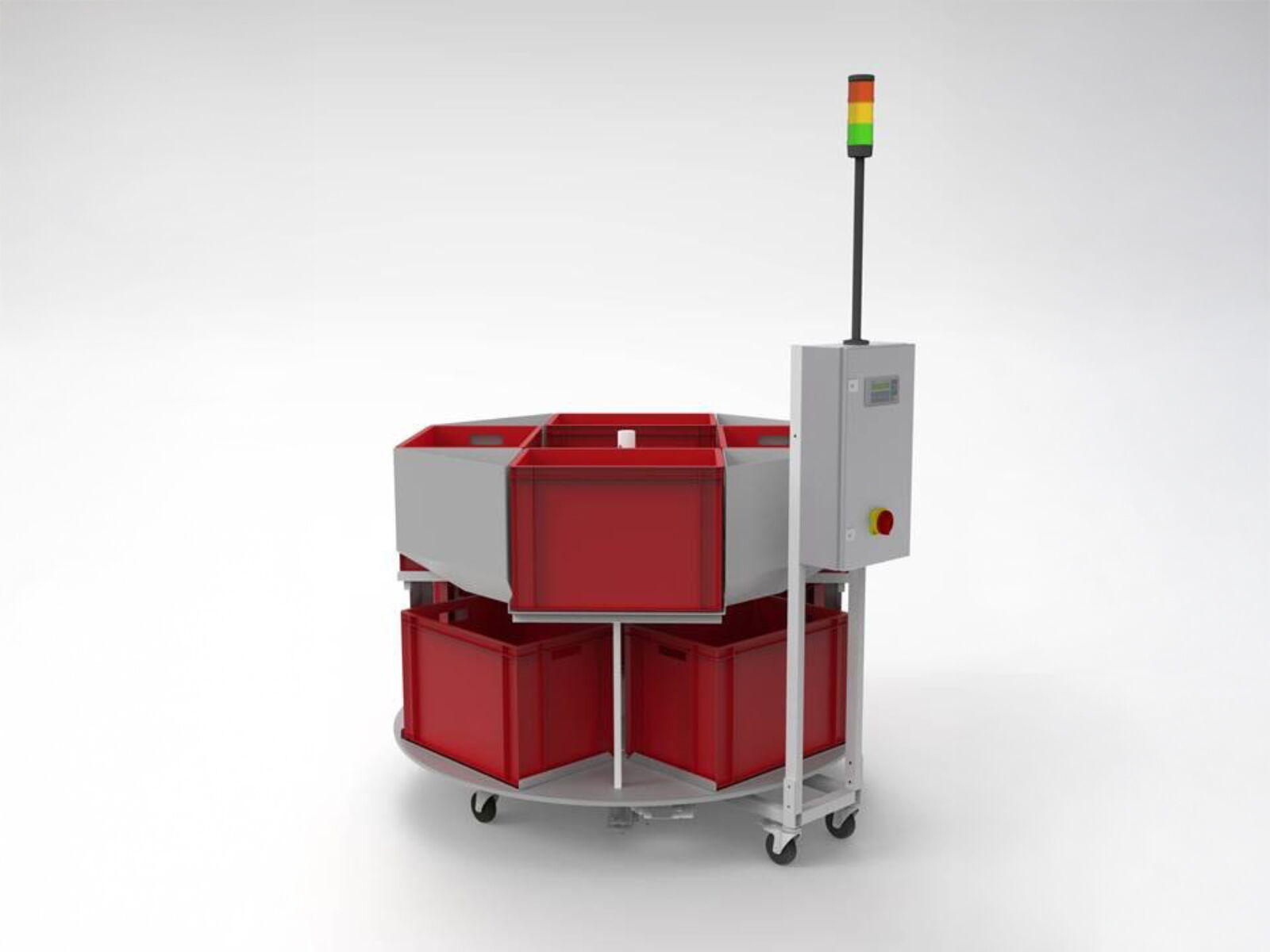
MTF Technik carousel storage stations are buffer systems consisting of a circular receiving plate as the base unit, which is mounted on a stable ball bearing ring so that it can rotate. The plate is driven from below by a three-phase motor with a friction wheel.

Boxes, cartons, KLTs, etc. can be placed on the turntable and filled at a fixed transfer point. Cams are mounted below the base plate, which are detected by a sensor and thus indicate the position. By attaching the cams accordingly, several stop positions can also be set up for each container if required to prevent spillage.

As an alternative to containers, bag holders or sack holders can also be attached to a rotating upper section. This allows the system to be used flexibly for different types of containers.

The holding systems can be used particularly space-effectively when containers are arranged in two levels one above the other. For example, eight standard KLTs with a base area of 600x400mm each can be accommodated on a turntable with a diameter of only 1,550mm.

The advantage of these carousel buffers is that they are relatively inexpensive and very simple in design. Maintenance is extremely low and reliability is very high due to the simple design. In addition, such systems are also very well suited for use in clean rooms, as they generate very little abrasion and all moving parts are located below the turntable.

MTF Technik carousel depot stations are individually designed and configured for each application to suit the customer's containers and the space available. They are typically used where a suitably circular installation site is available.

The basic control system for the pick-up systems is very simple, as it only has to control one drive and one sensor. Depending on the task at hand, the control functions can of course be made much more complex.

View

Carousel depot station

Efficient distribution and buffering of material MTF Technik 
Hardy Schürfeld GmbH & Co. KG

Conveyor belt with linear buffer

If production machines are positioned parallel to one another, there is often little space between them for a buffer solution. In addition, the machine usually needs to be accessible for set-up work. In such cases, MTF Technik conveyor belts can often be used as linear buffers.

Several containers (cardboard boxes, KLTs, etc.) are placed on a conveyor belt, which are then moved to the respective filling position in a controlled manner. The drive lugs on the conveyor belt ensure that there is always a small gap between the containers, which can be easily detected by a sensor. This allows each container to be clearly positioned at the filling position.

For more complex systems, pneumatic separation stations can also be used as an option to move containers to the jam position. This is particularly important if, for example, different container sizes are used and fixed cleat compartments are therefore not suitable, or if containers are to be pre-synchronised into a protective fence at the filling position.

The linear buffers can be installed very flat, so that feeding situations from low discharge chutes are also possible. The disadvantage of these systems is the relatively large space requirement, as the empty containers must first be stored and then buffered as full containers after the filling process. A buffer solution for three containers requires space for at least five containers (the last container remains in the filling position and the two already filled containers are pre-synchronised to the two free spaces).

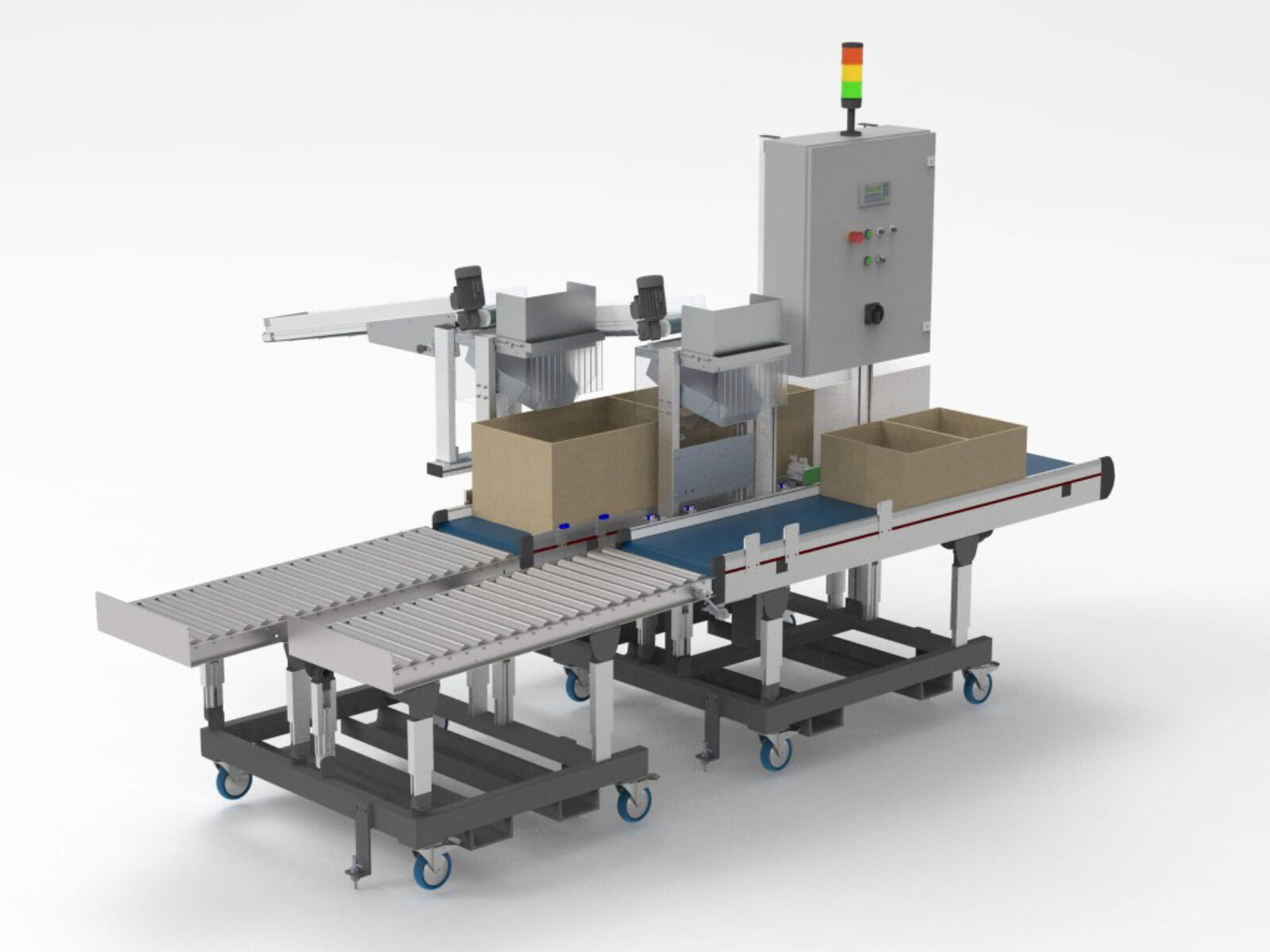
Optionally, the linear buffers can also be divided into two parts, i.e. the empty containers are fed to the filling station via a conveyor belt and the filled containers are transported away via a roller conveyor. This is useful if, for example, filling takes place within a protective fence or if, for space reasons, the filled containers can only be removed at the front delivery position. In this case, the combination with a roller conveyor offers the advantage that the filled containers can be removed independently of the feed of the empty containers.

As the linear buffers can be designed to be mobile, they can be easily removed from the production machine if necessary, allowing tool changes or similar operations to be carried out.

View

Conveyor belt Linear buffer

Efficient distribution and buffering of material MTF Technik 
Hardy Schürfeld GmbH & Co. KG

Multi-linea buffer


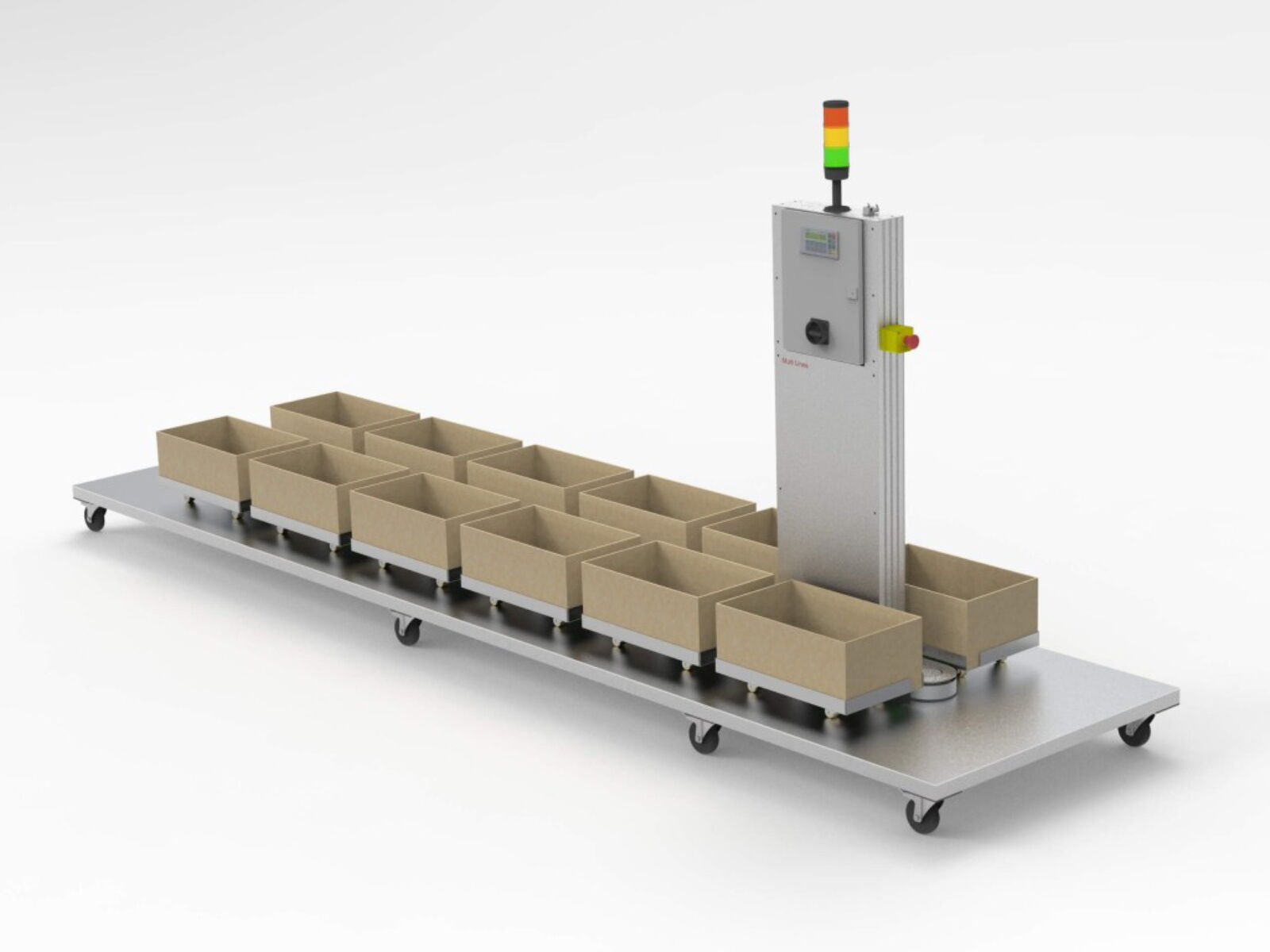
The "Multi-Linea" is a circulation buffer in which containers or bags are placed on small mobile trolleys that are pulled by a chain drive. The container or bag holders are customised to meet specific customer requirements.

This type of circulating buffer is suitable when there is sufficient space available lengthwise and the containers need to be positioned relatively low (e.g. because they are filled via a chute or similar). Thanks to the circulating operation, all spaces can be used for buffering, i.e. the space utilisation rate is high. The more containers are set up on the Multi-Linea, the better the space utilisation.

To avoid spillage, the system can pre-cycle parts per container to ensure that filling is as even as possible.

In the basic configuration, the system can be equipped with a very simple control system, e.g. if it is already installed in a protective fence. For more complex projects, a Siemens S7 control system is usually used, which is individually programmed. This allows special interfaces, optical and acoustic signals, recipe management, etc. to be implemented. The Multi-Linea systems can also be adapted in terms of safety equipment or clean room designs.

The Multi-Linea is usually designed to be mobile and can therefore be used flexibly at different locations. An advantage is that each container can be changed flexibly during operation, as they stand individually on the mobile trolley. This allows operators to remove filled containers and provide new, empty containers regardless of the filling level of the Multi-Linea. The system cycle does not have to be interrupted for this.

The standard Multi-Linea buffer systems usually have a capacity of between approx. 6 and 16 containers. The fewer containers required, the more suitable a carousel depot station is as an alternative, as these are cheaper and also take up less space. For larger numbers of containers, lift systems tend to be used to achieve better space utilisation through stacking.

View

Multi-linea buffer

Efficient distribution and buffering of material MTF Technik 
Hardy Schürfeld GmbH & Co. KG

Conveyor belts with cross transfer device
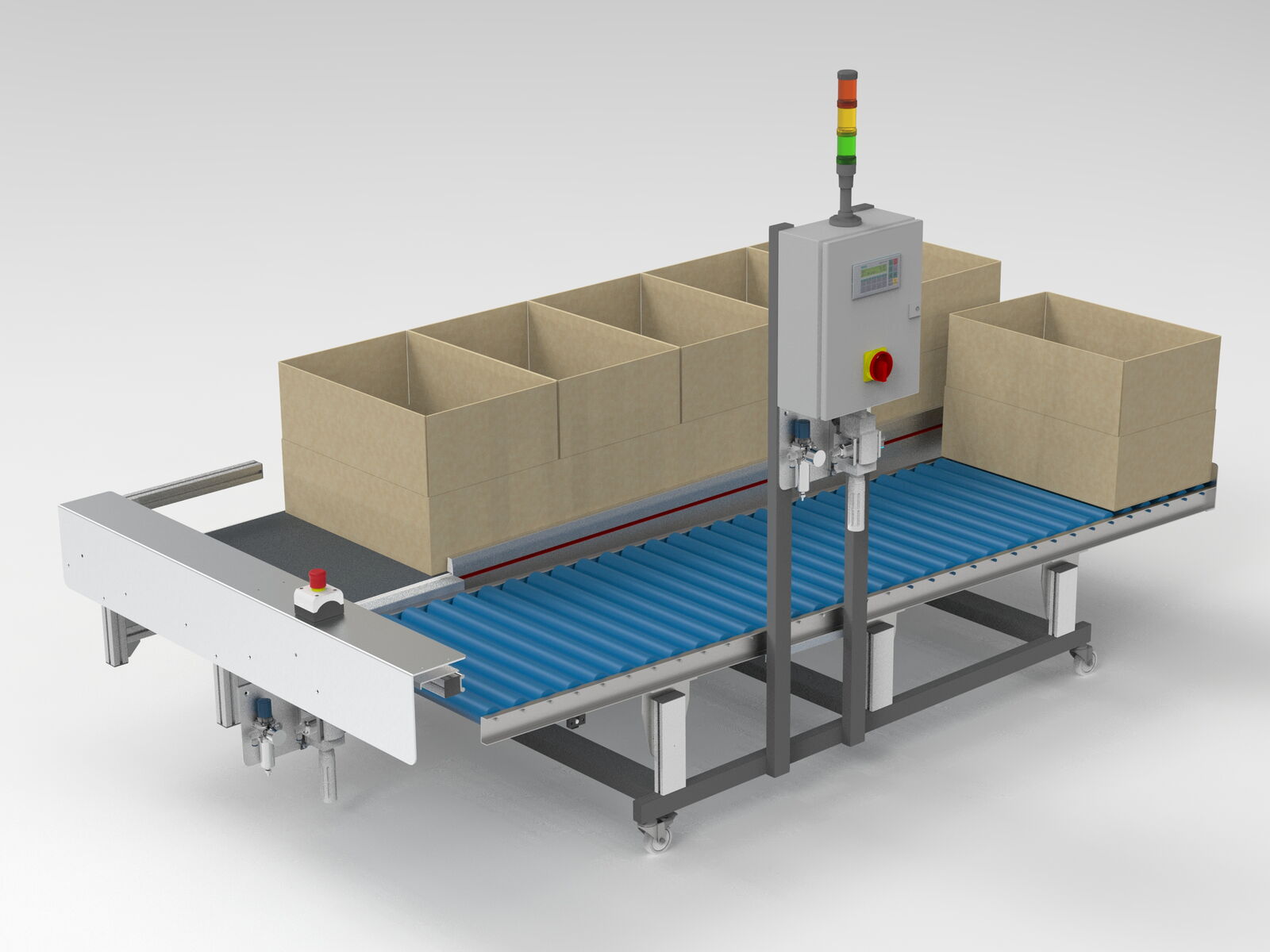
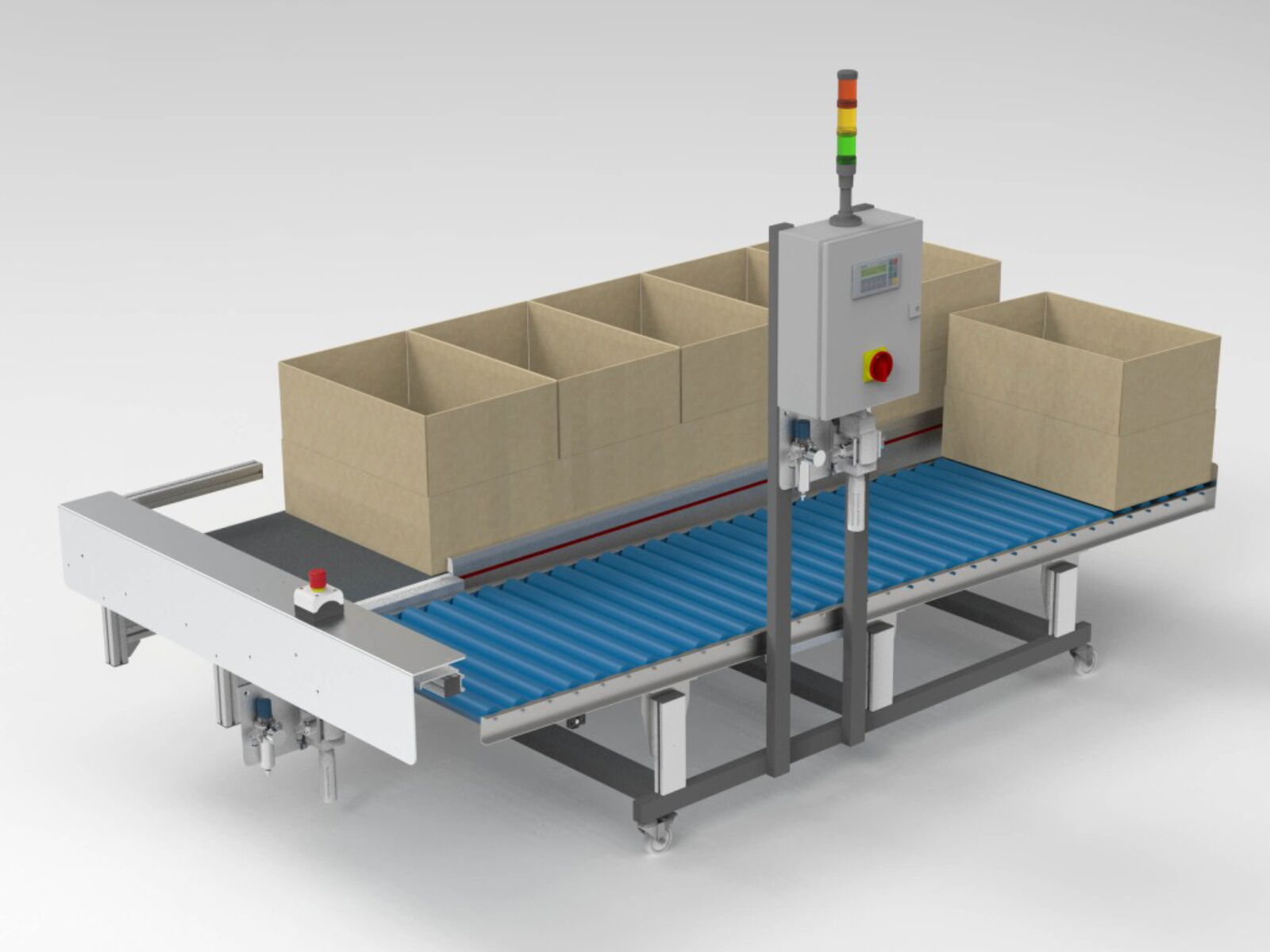
Conveyor belts with cross transfer devices are used when empty containers need to be fed and filled containers removed at a single point.

In this buffer system, the containers are transported in a U-shaped sequence, i.e. the operator places empty containers on a conveyor belt. These are moved forward and accumulated on the belt at the end of the belt by a stop. The containers are then usually filled at the stop position. Once the container is full, a pneumatic arm pushes it at a 90° angle to the conveyor belt onto a roller conveyor running parallel to the conveyor belt, which is inclined against the direction of travel of the feed belt. This causes the filled containers to run back towards the feed position on the roller conveyor after the cross transfer process.

This process is particularly recommended if filling is carried out by a robot system or similar, which is installed in a protective fence. The operator is outside the protective fence and can always push empty containers forward and remove filled containers from the roller conveyor in the same cycle without having to intervene in the production machine cycle.

The disadvantage of the combination of conveyor belt and roller conveyor is the poorer use of space, which is a maximum of 50%, as the conveyor belt is filled with empty containers and the same space must be provided on the roller conveyor for the containers that are filled later. To overcome this disadvantage, a second conveyor belt with an additional cross transfer can be used instead of the roller conveyor. In this case, only one container space needs to be left empty to allow the first cross transfer to take place. If the conveyor belts offer space for two containers each, for example, one space must be left free, i.e. 75% utilisation. If there is space for 10 containers on a conveyor belt, only one space must be left free, i.e. 19 out of 20 spaces and thus 95% of the conveyor belt area can be used. The containers can complete a full cycle, i.e. they return to the point where they were deposited as empty containers once they have been filled.

View

Conveyor belts with cross transfer device

Efficient distribution and buffering of material MTF Technik 
Hardy Schürfeld GmbH & Co. KG

Linear movable conveyor belts

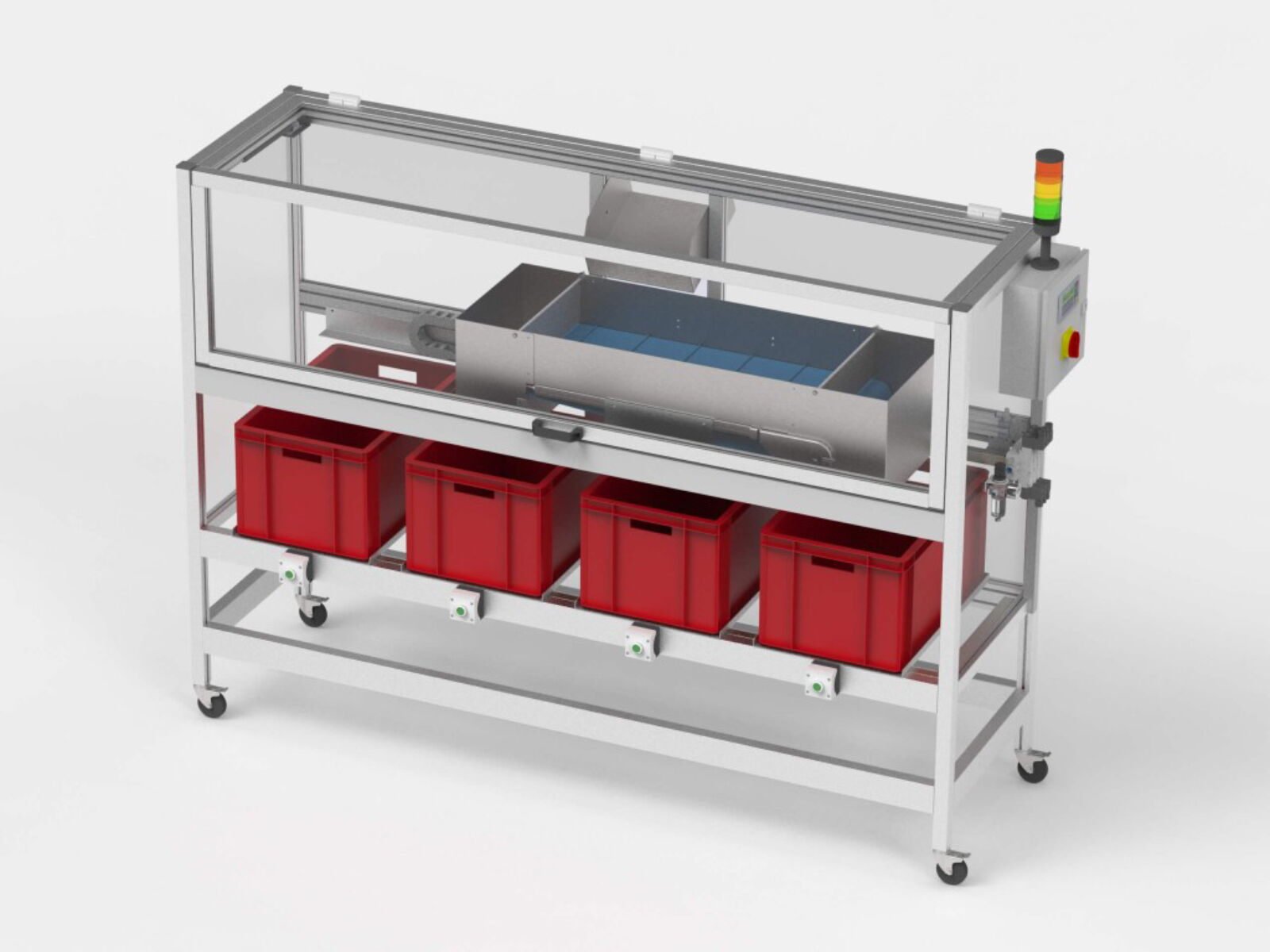
If very little space is available and only a relatively small number of containers need to be filled, a linearly movable conveyor belt is often a very efficient solution. The containers are arranged below a conveyor belt, which can be moved pneumatically or electrically in a longitudinal direction and has a reversible drive.

The material is then fed from above into the centre of the buffer.

The length of the conveyor belt is adjusted depending on the container dimensions and the installation situation. Depending on the conveying direction, container 1 or container 3 can be filled, for example. When the conveyor belt is moved linearly by one position, containers 2 or 4 are filled accordingly.

If required, additional stop positions can also be provided, e.g. to prevent spillage cones. It is also possible to mount distribution rockers or distribution switches at the outlets of the conveyor belt to create even more discharge positions.

This solution is extremely space-saving, as virtually only the floor space of the containers is required. The distribution technology is located above the containers and does not require any significant additional space. The containers are usually accessible at all times and can therefore be removed or emptied independently of the machine cycle.\

n

Since only the conveyed goods are transported here, virtually all container types can be used (KLT, cardboard boxes, bags, mesh boxes, etc.). Since the containers are not transported, their dimensional stability, etc. is not important. A mix of containers is also possible without any problems, provided that they can be positioned correctly at the delivery points of the movable conveyor belt.

Depending on the desired size, these systems are designed to be mobile so that they can be used flexibly at different locations.

View

Linear movable conveyor belt

Efficient distribution and buffering of material MTF Technik 
Hardy Schürfeld GmbH & Co. KG

Conveyor belts with discharge devices

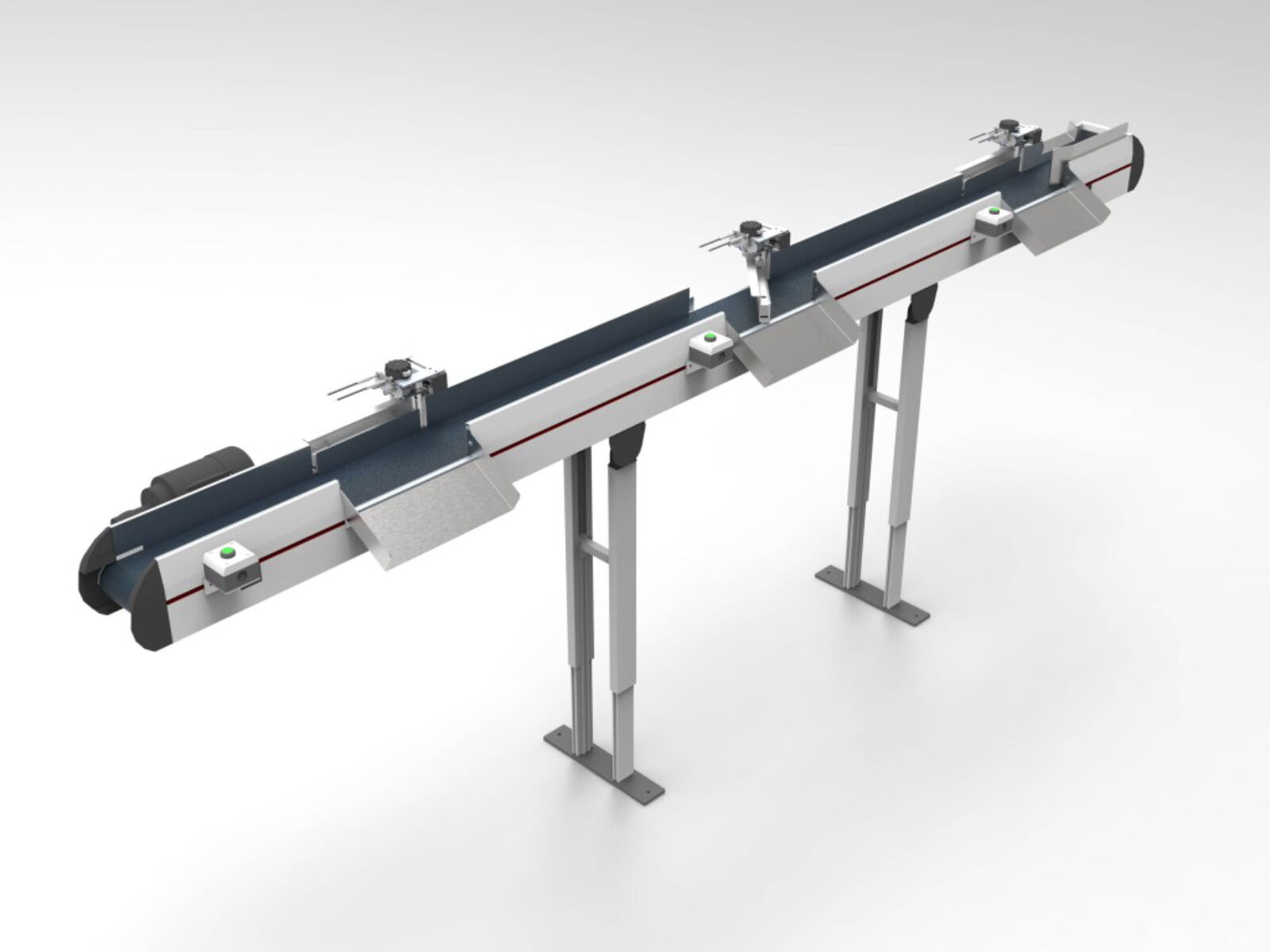
As with the concept of the linearly movable conveyor belt, containers can also be filled by a conveyor belt with several discharge points. In this case, a conveyor belt is mounted above the containers to be filled. At each container position, the side guide of the conveyor belt is removed and a discharge switch is installed instead, which diverts the flow from the conveyor belt to the side. When all switches are closed, they serve as side guides and the conveyed material is transported to the end of the conveyor belt.

This means that virtually any number of discharge points can be defined, which can be very close together or far apart. The solution can therefore be used for space-saving applications where the containers to be filled can be placed directly next to each other. However, this concept also makes it possible to supply larger containers or different storage hoppers on assembly machines, for example.

As with the linearly movable conveyor belts, only the conveyed goods are transported, not the containers. The system can therefore be used flexibly for different container types.

View

Conveyor belt discharge

Efficient distribution and buffering of material MTF Technik 
Hardy Schürfeld GmbH & Co. KG

Multi-level conveyor belt systems with lift

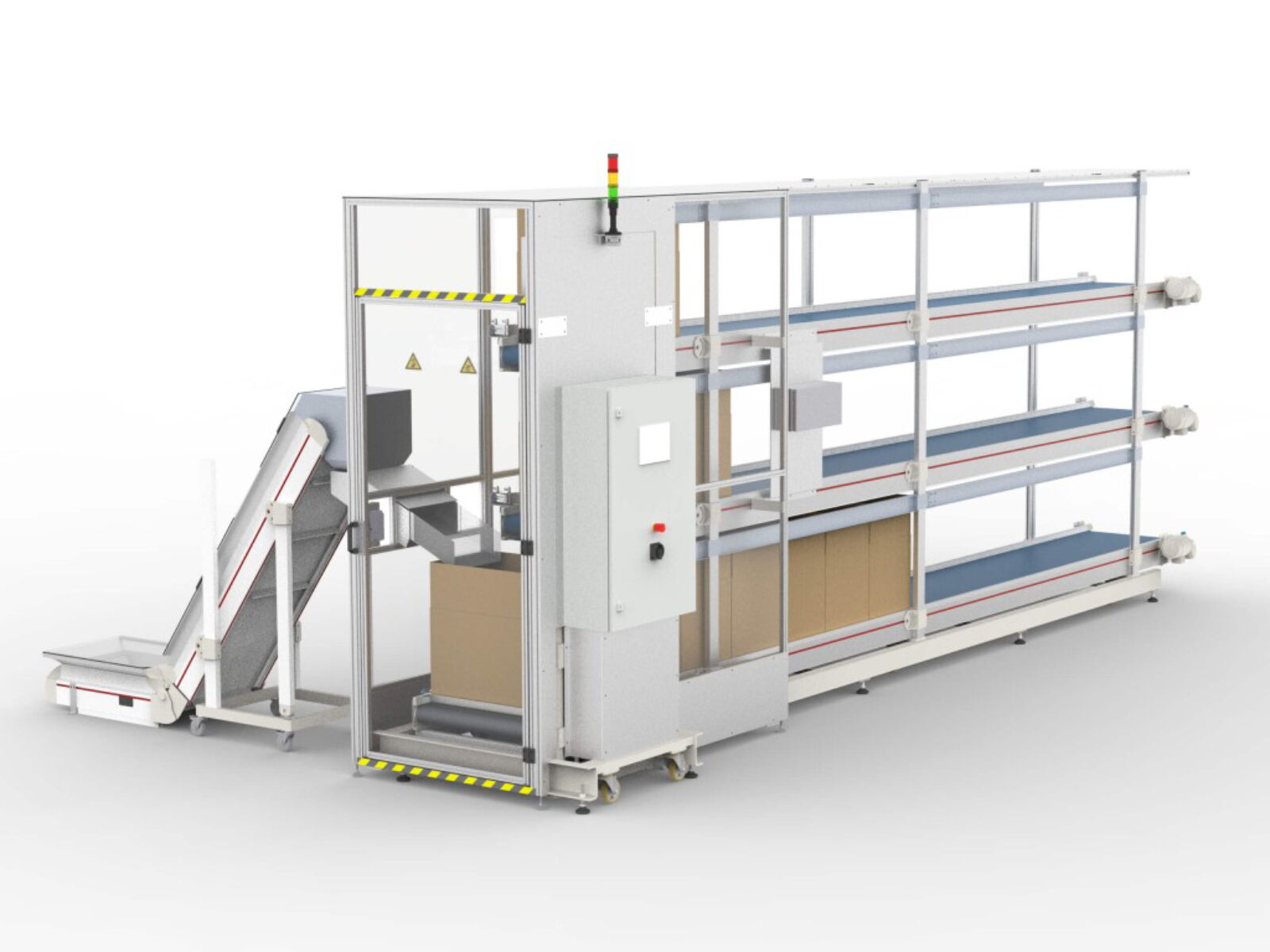
Especially when you need a lot of buffer capacity or autonomy for the container storage, or when space is tight, multi-level conveyor belts are a great choice, especially when paired with lift conveyors. Here, the containers are loaded and unloaded on top of each other on several conveyor lines and made available at the filling position.

Depending on requirements, systems with one lifting station in combination with multi-level conveyor belts or, in special cases, systems with two lifting stations are used. In systems with one lifting station, one level must remain free in the floor buffer. The other levels are filled with empty containers accordingly. However, the first filled container is then transported to the still empty storage level before the next empty container can be made available.

When using two lifting stations, on the other hand, all levels can be fully utilised, i.e. space utilisation is maximised. Here, filled containers can be stored on one level and empty containers can be fed from the same level for filling at the same time. This usually also reduces the time required to provide a new, empty container.

Similarly, a system with two lift lifts can maintain strict FIFO, which is usually not possible with only one lift lift. This can be important, for example, if the buffer system is integrated into a process in order to cool or cure components before they are further processed.

In practice, most multi-level conveyor belt systems are designed to accommodate containers. However, depending on the size and geometry of the components, individual parts can also be buffered.

Due to the usual size of such systems, multi-level conveyor belt systems with lift systems are usually permanently installed and must also be equipped with appropriate protective enclosures or be subject to very precise safety checks.

View

Multi-level conveyor belt system with lift
Efficient distribution and buffering of material MTF Technik 
Hardy Schürfeld GmbH & Co. KG

Control functions for buffer systems

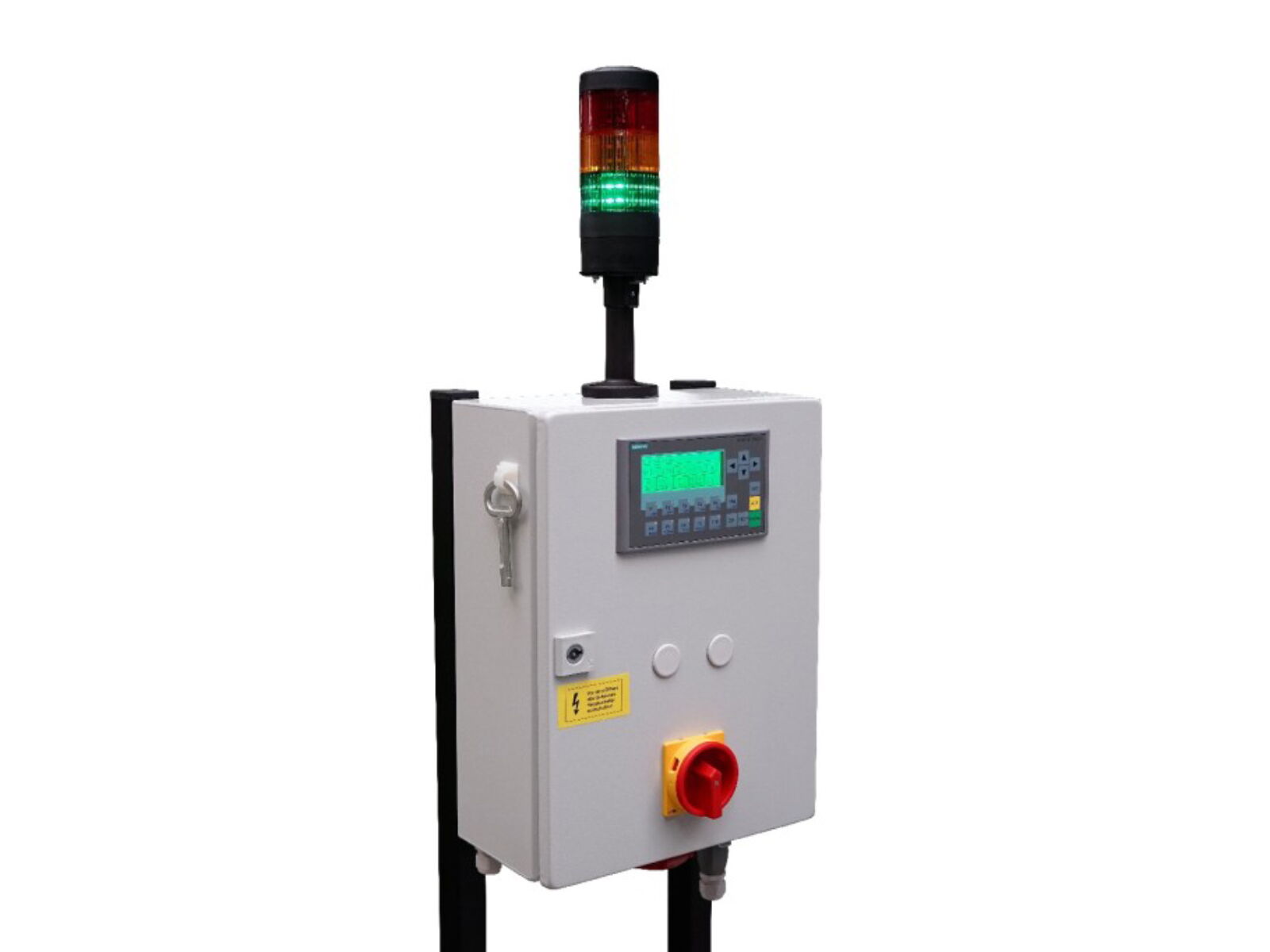
Most buffer systems require a control system, especially if, for example, a certain quantity of components is to be stored and transported in a container.

Depending on the complexity of the systems and the desired functionalities, the buffer systems can be controlled via existing control systems on production machines, etc. This would be the simplest and most cost-effective option.

In most cases, however, the buffer system is controlled separately and connected to the production plant and, if necessary, to other transport systems, etc. via an interface. The following basic functions are usually covered:

1. Counting function, i.e. a container change should take place after a certain number of components or machine cycles. For this purpose, a corresponding target number of pieces per container is entered in the control system. The counting function usually includes an input option for a cavity number, i.e. a multiplier for how many parts are produced per machine cycle or per signal.

2. As an alternative to the counting function, a time function may be useful in certain cases, i.e. the container is changed after a certain time. This function is necessary, for example, if there is no signal-based evaluation of the production quantity or no connection to the production machine.

3. Follow-up time. There is usually a certain distance between the place where the product is created (e.g. in a machine tool) and the container to be filled. This means that the counting pulse occurs before the product arrives in the desired container. If, after the production process, the component lands on a conveyor belt, for example, and is then transported to the container, the time required for the transfer must be determined. Once the target number of pieces has been reached, the conveyor belt must first run continuously until the counted part has been transported to the container.

Other possible control functions include counting the components using a weighing system, which is connected to the control system depending on the product and the desired accuracy. For this purpose, reference weights are stored for each item and a desired target number of pieces or a target weight per container is queried.

There are also functions that allow different components to be entered with their corresponding parameters (keyword: recipe management). This simplifies operation when different, recurring items are to be produced and buffered.

Depending on customer requirements, various displays, connectors, interfaces, cable lengths, control cabinet designs, signal lights, acoustic elements, operating elements, etc. can be integrated.

View

Control unit

Efficient distribution and buffering of material MTF Technik 
Hardy Schürfeld GmbH & Co. KG
Efficient distribution and buffering of material MTF Technik 
Hardy Schürfeld GmbH & Co. KG