

Plant linkage for ammunition parts
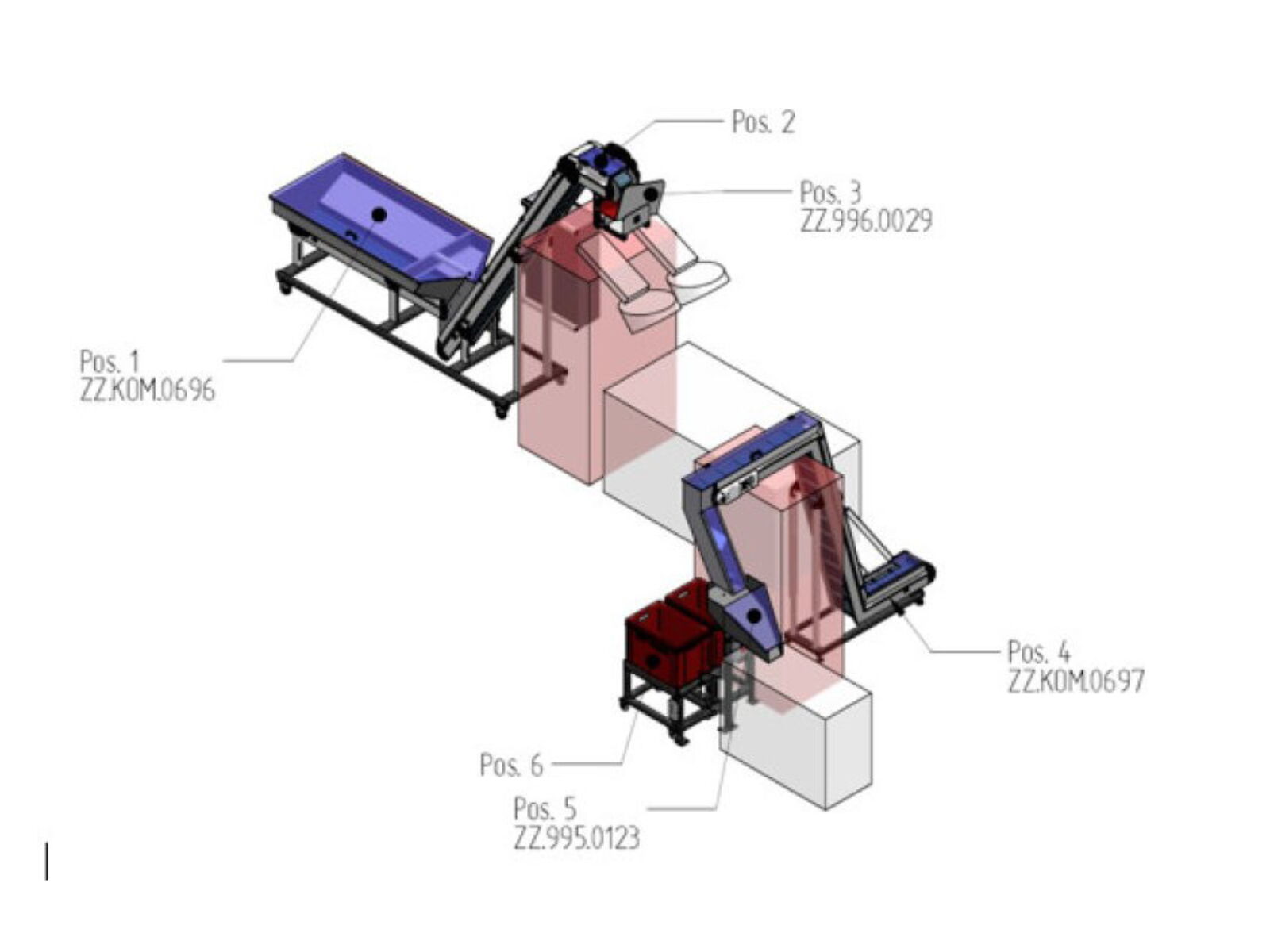
Task: Gentle transport of cartridge cases to the production machine
Cartridge cases are to be emptied from plastic containers into a bunker and fed to a production machine as needed. The bunker volume is to be 300 liters.
Approximately 250 cartridge cases are processed per minute.
The production machine has two vibrating pots, the fill levels of which are monitored on-site by sensors. The feed rate is to be controlled according to requirements.
After the first production machine, the cartridge cases are to be conveyed to a second machine, or alternatively distributed to buffer containers.
Parts must be transported carefully; no damage to the parts may be visible. Jamming of parts must be reliably prevented.
Interfaces to the two production machines must be processed in the control system.
Passageways for people must remain clear at the machines (shown as a red block in the drawing). Very little space is available.
The highest priority is placed on process reliability, i.e., no sleeves may remain on the conveyor belts during a batch change, the presence of the containers must be checked, a container change must be acknowledged, etc.
Solution: Combination of low-noise conveyor belts with diverter and multi-rounder
Combination of a GL conveyor belt with large stainless steel hopper and a PL conveyor belt with attached pneumatic diverter for distributing the flow to the vibratory pots
ZL conveyor belt with a fixed 75° bend following the first production machine, with an attached chute for transfer to a rounder. The chute is made of special stainless steel acoustic sheeting for noise reduction, with welded-in cascades to reduce the falling speed.
Rounder with polycarbonate cover for portioning either into the feed hopper of the second processing machine or for filling the containers
The PL and ZL conveyor belts each feature a highly durable polyester belt (MTF running surface no. 12) with extra-long cleats. The belt is guided, ensuring a minimal gap between the guide profile and the cleat edge.
The inner surfaces of the guide profiles on the conveyor belts are completely lined with stainless steel. All sheet metal joints are welded and smoothed to eliminate any visible edges.
Sophisticated control system, manufactured by VIPA (similar to Siemens S7), for controlling the entire system including mapping the interfaces to the production machines
In the steep sections of the conveyor belts, a flexible material is placed above the running surface, which prevents the parts from falling back.
All conveyor belts are covered from above with polycarbonate.